DayPilot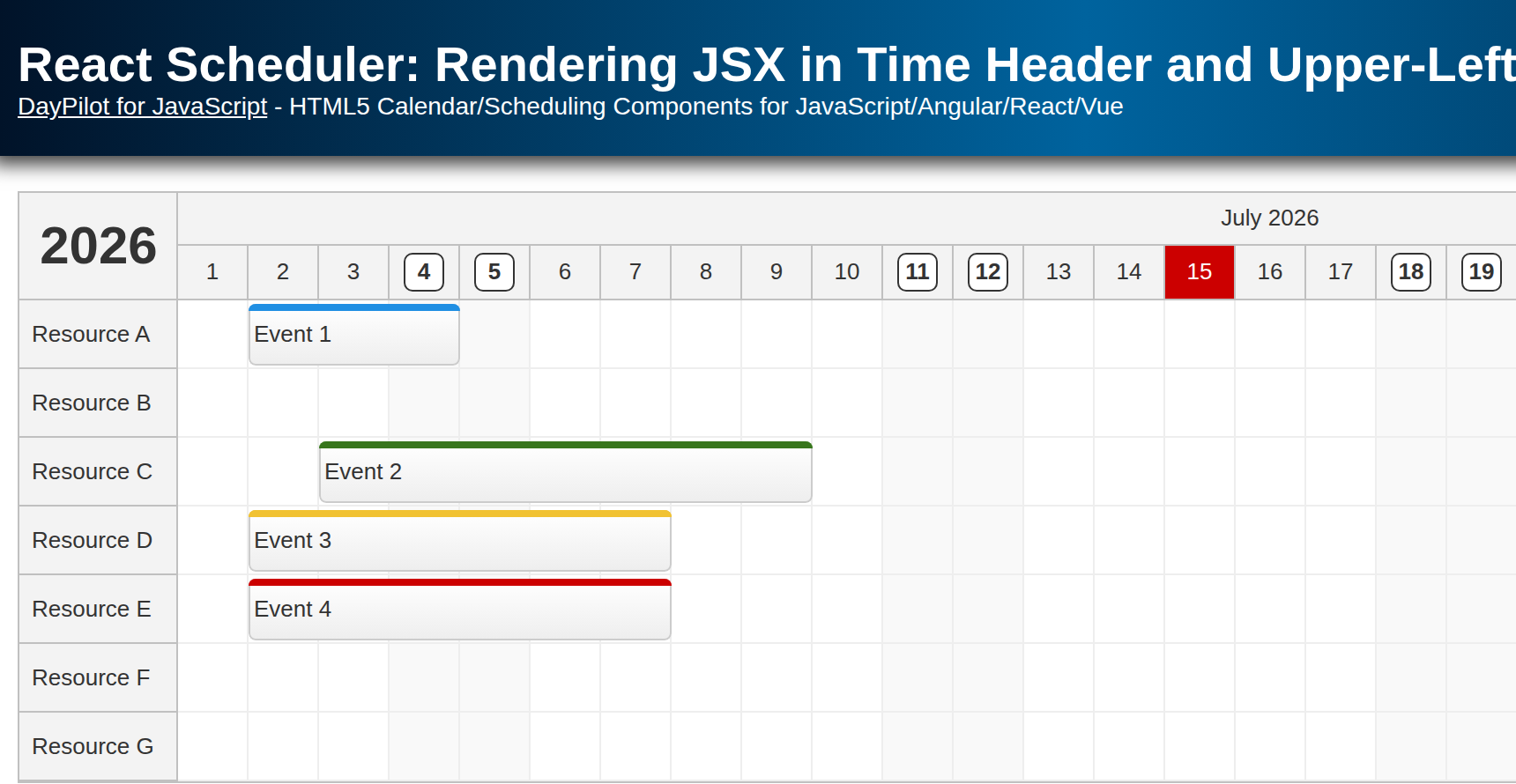
| Demo | |
|---|---|
| Downloads | |
| Repository | |
| Languages | JavaScript |
| Technologies | ReactJSX |
| Code License | Apache License 2.0 (Open-Source) |
Features
Display JSX components in the upper-left corner of the React Scheduler component
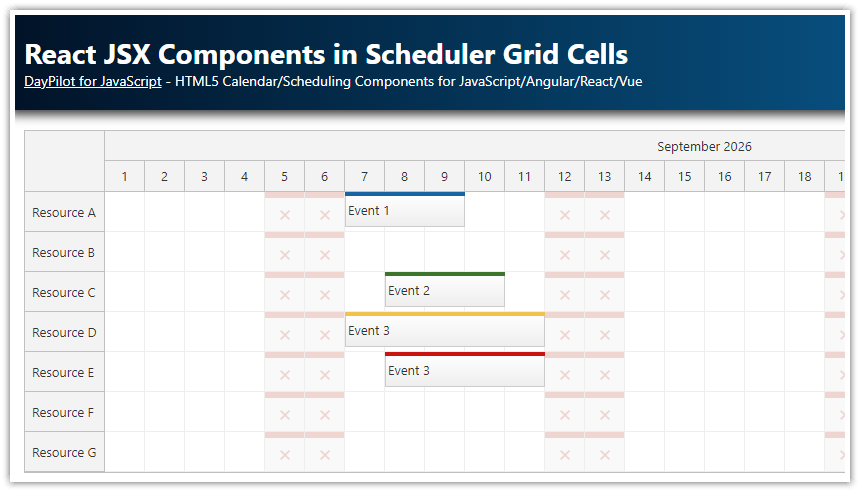
Customize the Scheduler time header using JSX (for example, to highlight weekends)
For an introduction to using the React Scheduler component, please see the React Scheduler Component Tutorial.
License
The sample uses DayPilot Lite for JavaScript. The source code and licensing information are included in the download package.
Rendering JSX in the Upper-Left Corner of the Scheduler
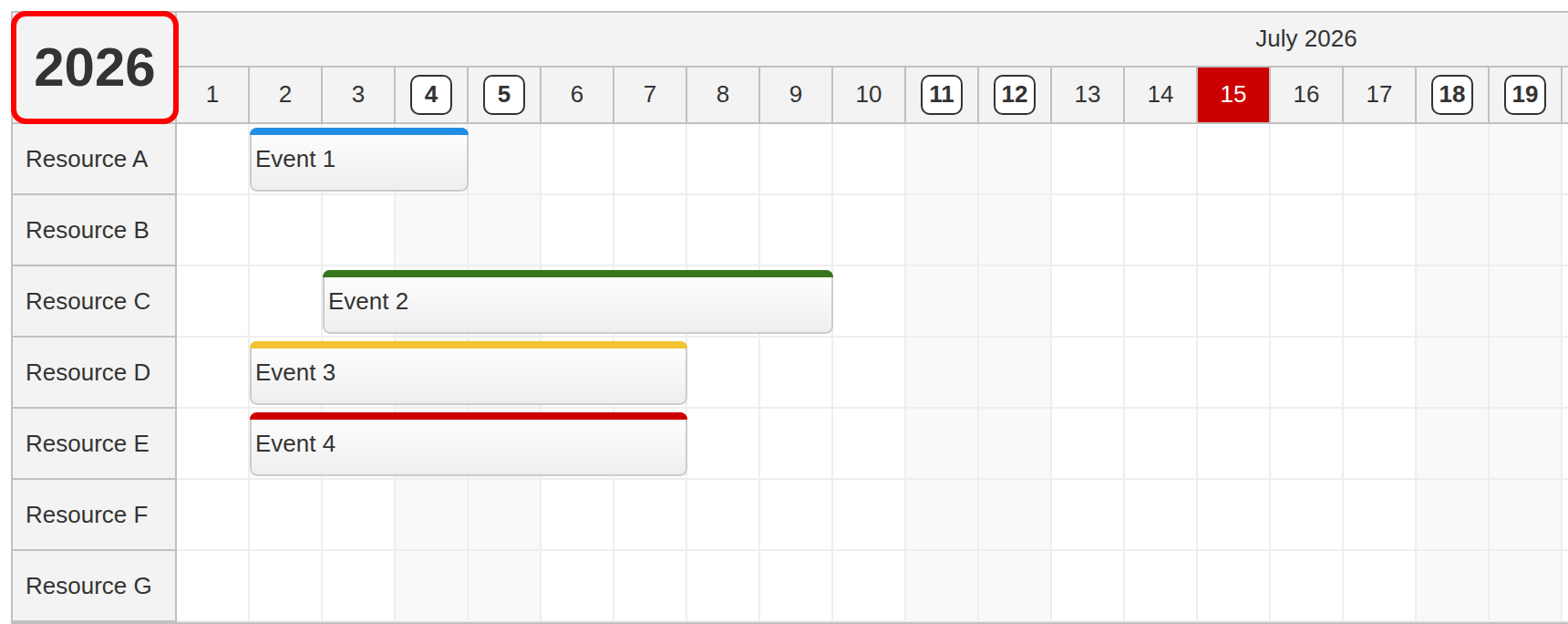
The React Scheduler can render custom JSX in the upper-left corner. You can use it to display the visible year of the current date range, or add action buttons or navigation elements.
Use the onBeforeCornerDomAdd prop to specify the JSX:
const cornerStyle = {
  fontSize: '30px',
  fontWeight: 'bold',
  height: '100%',
  display: 'flex',
  alignItems: 'center',
  justifyContent: 'center',
};

<DayPilotScheduler
  onBeforeCornerDomAdd={(args) => {
    args.element = <div style={cornerStyle}>{args.control.startDate.toString('yyyy')}</div>;
  }}
/>
This event handler will be called whenever the Scheduler component is updated.
React JSX Components in the Time Header
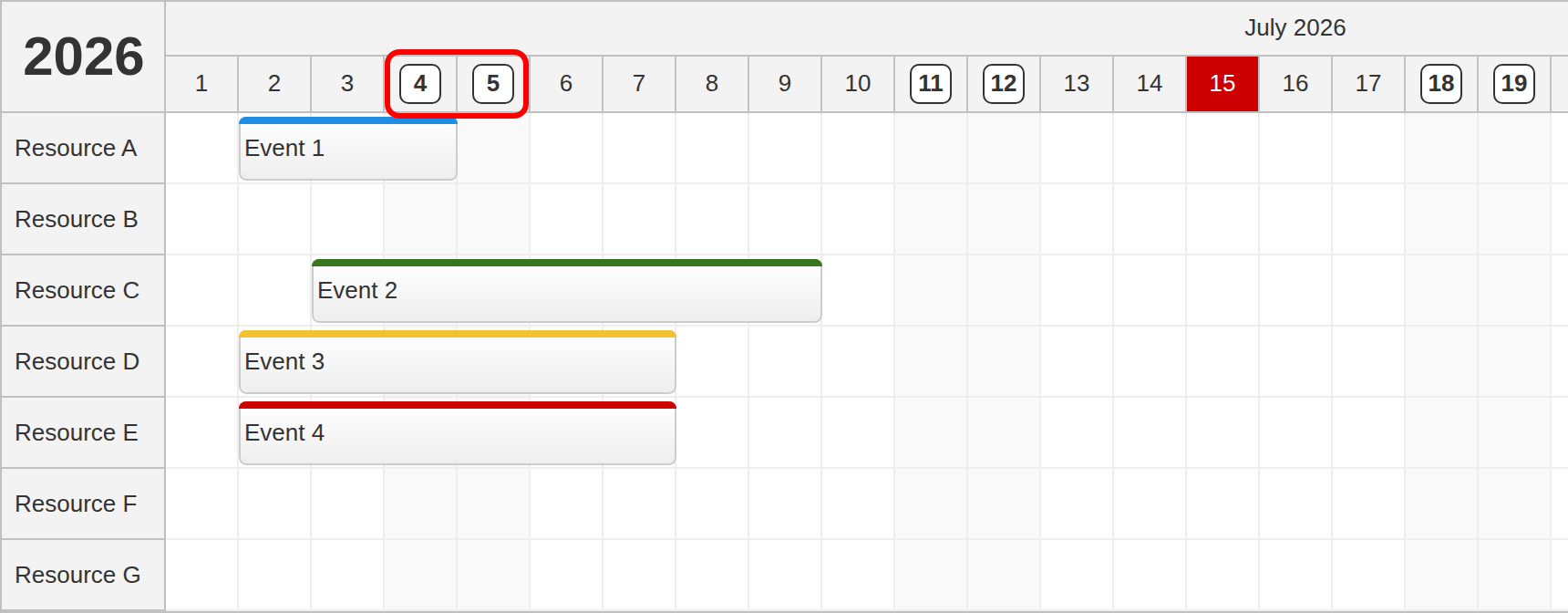
You can replace the default time header cell content with a custom JSX element or component using the onBeforeTimeHeaderDomAdd event handler:
const weekendHeaderStyle = {
  fontWeight: 'bold',
  border: '1px solid #333',
  backgroundColor: 'white',
  padding: '2px',
  width: '17px',
  textAlign: 'center',
  display: 'inline-block',
  borderRadius: '5px',
};

<DayPilotScheduler
  onBeforeTimeHeaderDomAdd={(args) => {
    if (args.header.level !== 1) {
      return;
    }

    const dayOfWeek = args.header.start.getDayOfWeek();
    const weekend = dayOfWeek === 6 || dayOfWeek === 0;
    if (weekend) {
      args.element = <span style={weekendHeaderStyle}>{args.header.start.toString('d')}</span>;
    }
  }}
/>
This example adds a highlighted date to weekend time header cells.
Changing the Time Header Cell Properties
In addition to inserting a custom JSX component, you can also adjust the time header cell properties using the onBeforeTimeHeaderRender event handler. This event handler lets you customize selected styles (such as background color) and specify the content using HTML. The HTML content would be replaced by the JSX if you set args.element in onBeforeTimeHeaderDomAdd.
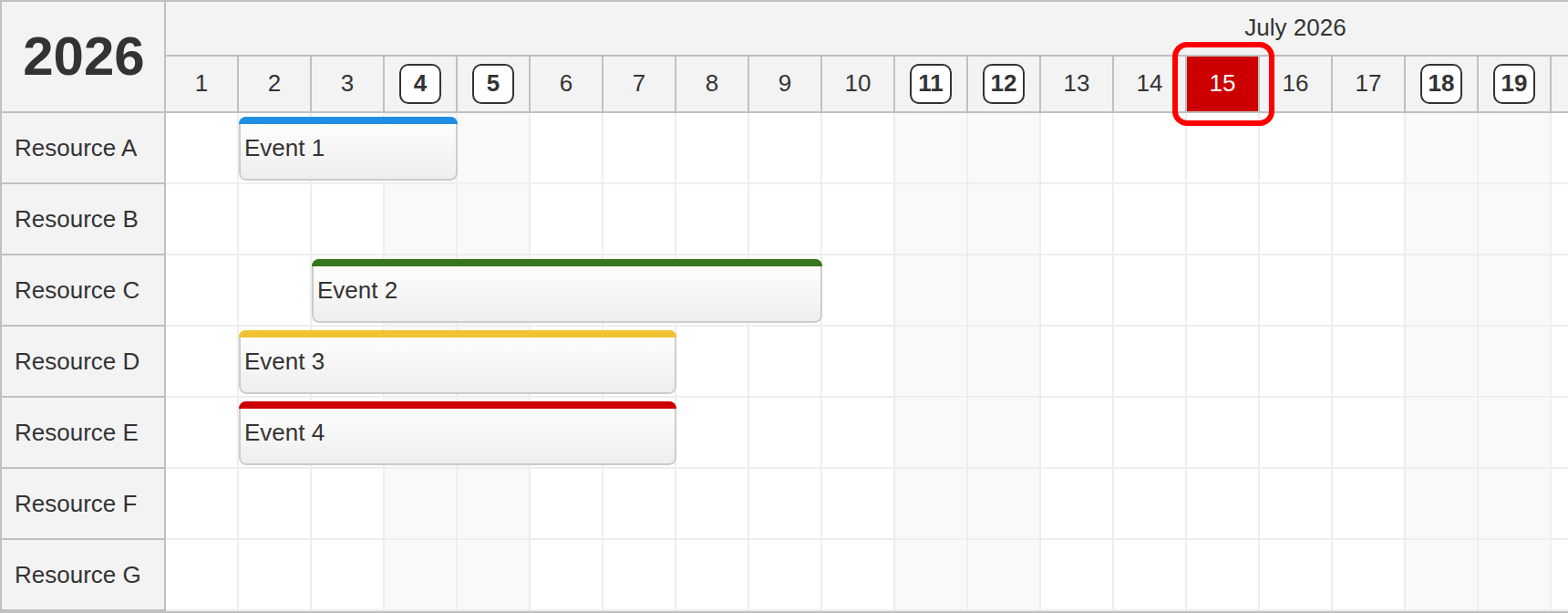
This sample shows the current month and highlights today by setting a custom foreground and background color. In DayPilot, direct comparison of equal DayPilot.Date values is valid, so the date check can stay simple:
const today = DayPilot.Date.today();
const startDate = today.firstDayOfMonth();
const highlightedDate = today;

<DayPilotScheduler
  onBeforeTimeHeaderRender={(args) => {
    if (args.header.level === 1 && args.header.start === highlightedDate) {
      args.header.backColor = '#cc0000';
      args.header.fontColor = '#ffffff';
    }
  }}
/>
Using Active Areas to Customize the Time Header
In the Pro version, the onBeforeTimeHeaderRender event handler can also be used to insert active areas into the time headers. In the Scheduler Time Header Customization tutorial, this method is used to create custom time header units:

Full Source Code
Here is the full source code of the customized React Scheduler component. It shows the current month, renders the visible year in the upper-left corner, highlights weekend headers using JSX elements, emphasizes today's header cell using onBeforeTimeHeaderRender, and passes Scheduler options as inline React props instead of a separate config object.
import { useState } from 'react';
import { DayPilot, DayPilotScheduler } from '@daypilot/daypilot-lite-react';

const today = DayPilot.Date.today();
const startDate = today.firstDayOfMonth();
const highlightedDate = today;

const weekendHeaderStyle = {
  fontWeight: 'bold',
  border: '1px solid #333',
  backgroundColor: 'white',
  padding: '2px',
  width: '17px',
  textAlign: 'center',
  display: 'inline-block',
  borderRadius: '5px',
};

const cornerStyle = {
  fontSize: '30px',
  fontWeight: 'bold',
  height: '100%',
  display: 'flex',
  alignItems: 'center',
  justifyContent: 'center',
};

const Scheduler = () => {
  const [resources] = useState(() => [
    { name: 'Resource A', id: 'A' },
    { name: 'Resource B', id: 'B' },
    { name: 'Resource C', id: 'C' },
    { name: 'Resource D', id: 'D' },
    { name: 'Resource E', id: 'E' },
    { name: 'Resource F', id: 'F' },
    { name: 'Resource G', id: 'G' },
  ]);

  const [events] = useState(() => [
    {
      id: 1,
      text: 'Event 1',
      start: startDate.addDays(1),
      end: startDate.addDays(4),
      resource: 'A',
    },
    {
      id: 2,
      text: 'Event 2',
      start: startDate.addDays(2),
      end: startDate.addDays(9),
      resource: 'C',
      barColor: '#38761d',
      barBackColor: '#93c47d',
    },
    {
      id: 3,
      text: 'Event 3',
      start: startDate.addDays(1),
      end: startDate.addDays(7),
      resource: 'D',
      barColor: '#f1c232',
      barBackColor: '#f1c232',
    },
    {
      id: 4,
      text: 'Event 4',
      start: startDate.addDays(1),
      end: startDate.addDays(7),
      resource: 'E',
      barColor: '#cc0000',
      barBackColor: '#ea9999',
    },
  ]);

  return (
    <div>
      <DayPilotScheduler
        timeHeaders={[{ groupBy: 'Month' }, { groupBy: 'Day', format: 'd' }]}
        scale="Day"
        days={startDate.daysInMonth()}
        startDate={startDate}
        rowMarginTop={2}
        rowMarginBottom={2}
        rowHeaderWidth={90}
        onTimeRangeSelected={async (args) => {
          const scheduler = args.control;
          const modal = await DayPilot.Modal.prompt('Create a new event:', 'Event 1');
          scheduler.clearSelection();
          if (modal.canceled) {
            return;
          }
          scheduler.events.add({
            start: args.start,
            end: args.end,
            id: DayPilot.guid(),
            resource: args.resource,
            text: modal.result,
          });
        }}
        treeEnabled={true}
        onBeforeTimeHeaderRender={(args) => {
          if (args.header.level === 1 && args.header.start === highlightedDate) {
            args.header.backColor = '#cc0000';
            args.header.fontColor = '#ffffff';
          }
        }}
        onBeforeTimeHeaderDomAdd={(args) => {
          if (args.header.level !== 1) {
            return;
          }

          const dayOfWeek = args.header.start.getDayOfWeek();
          const weekend = dayOfWeek === 6 || dayOfWeek === 0;
          if (weekend) {
            args.element = <span style={weekendHeaderStyle}>{args.header.start.toString('d')}</span>;
          }
        }}
        onBeforeCornerDomAdd={(args) => {
          args.element = <div style={cornerStyle}>{args.control.startDate.toString('yyyy')}</div>;
        }}
        events={events}
        resources={resources}
      />
    </div>
  );
};

export default Scheduler;
History
July 15, 2026: Updated the sample to DayPilot Lite with the React 19/Vite project structure, and updated the demo to show the current month and highlight today.
August 3, 2021: Updated the sample to React 17 and DayPilot Pro 2021.3.
November 22, 2019: Initial release.